Skip to content
  • de
  • en
  • Chair of Urban Development
  • TUM School of Engineering and Design
  • Technical University of Munich
Technical University of Munich
  • Urban Development
  • Team
    • Nadia Alaily-Mattar
    • Karin Eichinger
    • Matthias Ottmann
    • Former Team Members
      • Markus Weinig
      • Christiane Müller
  • Teaching
    • Current Student Projects
    • Completed Student Projects
    • Theses
  • Research
    • Ongoing Dissertations
    • Completed Dissertations
  • Publications
  1. Urban Development

This was the website of the Chair of Spatial Development.
 The new website of the Chair of Urban and Spatial Development is currently under construction and will be available shortly.

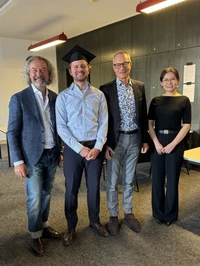
Neue Dissertation: The Dynamic Geographies of the Knowledge Economy in Germany: Where do firms & workers locate?

This dissertation examines the German knowledge economy over two decades and explores where firms and knowledge workers locate. It examines the spatial, relational and economic location decisions through three studies on firm location choices, the influence of the knowledge economy on employment growth and the (re-)location of workers. Using ERGM, Granger causality and origin-destination data analysis, it reveals how proximity, the type of knowledge, infrastructure and connectivity influence where firms and workers locate, thus, regional growth.

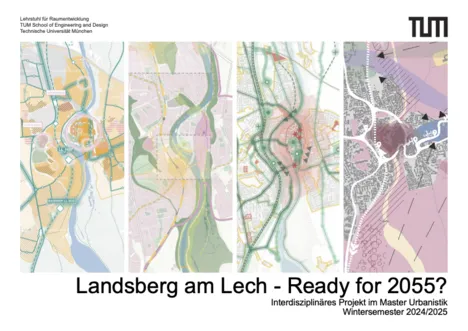
Project Documentation: "Landsberg am Lech - Ready for 2055?"

NEWS| 31.03.2025 

Project Documentation: "Landsberg am Lech - Ready for 2055?"

Students from the Master's programs in Urbanism and Architecture worked for several months to look at the long-term development of the town of Landsberg. The aim was to design a long-term spatial strategy. Based on a comprehensive analysis of the region and a methodology for working with future trends, the next 30 years were examined. Four student teams each present a vision of the future for “Landsberg 2055” and use an overall strategy and specific spatial proposals to show possible development paths for the region and local stakeholders.


The four student teams focus on different topics and show different development paths for the year 2055. How can resilient land use, inclusive mobility and social cohesion be strengthened and interlinked to achieve sustainable growth? How can the prospects of young residents be improved and education and innovation become key catalysts for positive development? How can Landsberg become a municipality that leads by example through the consistent implementation of sustainable mobility, a liveable city center and a self-sufficient energy supply? And how can Landsberg carry today's qualities into the future in order to be “just as great, only better” in 2055?

Link to the digital documentation (PDF, ca. 70 MB) available on mediaTUM.

2006-2007 Location networks of the Munich Metropolitan Region. On connectivity in the knowledge economy

Forschung, PAGE:TUMvCard | 01.04.2013


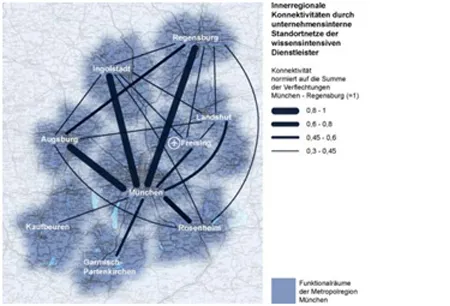
Topic: The research project aims to investigate the functional, non-physical relationships established by the activities of companies in the knowledge economy, both quantitatively and qualitatively, from a spatial perspective.

Brief description: The study examines the location interdependencies of the knowledge economy in the Munich Metropolitan Region. The central question is the extent of the Metropolitan Region through the entrepreneurial networks and how the functional-spatial hierarchy between the individual functional areas of the Metropolitan Region presents itself. The two central pillars of the knowledge economy are being examined: the knowledge-intensive service and high-tech industries. A distinction is made between internal and external company location networks. The intensity of these relationships - referred to as connectivity - is examined on four spatial scales: regional, national, European and global. Nine urban functional areas of the Munich metropolitan area are used as the smallest spatial analysis unit: Munich, Augsburg, Ingolstadt, Rosenheim, Freising, Landshut, Regensburg, Garmisch-Partenkirchen and Kaufbeuren.

Participating team members: Alain Thierstein, Viktor Goebel, Stefan Lüthi, Agnes Förster

Client: LH Munich, Department of Urban Planning and Building Regulations, Department of Labour and Economics, Flughafen München GmbH, City of Rosenheim, County of Rosenheim, IFG Ingolstadt GmbH, GFS e.V.


◄
To top

Contact


Chair of Urban Development
Arcisstr. 21
D-80333 Munich

Room 4161
U-Bahn-Station Theresienstraße (U2, U8)

Phone
+49 89 289 22489

Email
info.re@ed.tum.de

Newsletter


Subscribe to our Newsletter here

  • Privacy
  • Imprint
  • Accessibility