
This was the website of the Chair of Spatial Development. The new website of the Chair of Urban and Spatial Development is currently under construction and will be available shortly.
Neue Dissertation: The Dynamic Geographies of the Knowledge Economy in Germany: Where do firms & workers locate?
This dissertation examines the German knowledge economy over two decades and explores where firms and knowledge workers locate. It examines the spatial, relational and economic location decisions through three studies on firm location choices, the influence of the knowledge economy on employment growth and the (re-)location of workers. Using ERGM, Granger causality and origin-destination data analysis, it reveals how proximity, the type of knowledge, infrastructure and connectivity influence where firms and workers locate, thus, regional growth.
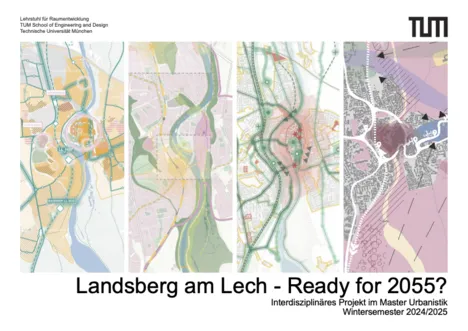
Project Documentation: "Landsberg am Lech - Ready for 2055?"
NEWS| 31.03.2025
Project Documentation: "Landsberg am Lech - Ready for 2055?"
Students from the Master's programs in Urbanism and Architecture worked for several months to look at the long-term development of the town of Landsberg. The aim was to design a long-term spatial strategy. Based on a comprehensive analysis of the region and a methodology for working with future trends, the next 30 years were examined. Four student teams each present a vision of the future for “Landsberg 2055” and use an overall strategy and specific spatial proposals to show possible development paths for the region and local stakeholders.
The four student teams focus on different topics and show different development paths for the year 2055. How can resilient land use, inclusive mobility and social cohesion be strengthened and interlinked to achieve sustainable growth? How can the prospects of young residents be improved and education and innovation become key catalysts for positive development? How can Landsberg become a municipality that leads by example through the consistent implementation of sustainable mobility, a liveable city center and a self-sufficient energy supply? And how can Landsberg carry today's qualities into the future in order to be “just as great, only better” in 2055?
Link to the digital documentation (PDF, ca. 70 MB) available on mediaTUM.
2010 International Workshop on Spatial Strategy, February 2010
Forschung, PAGE:TUMvCard |
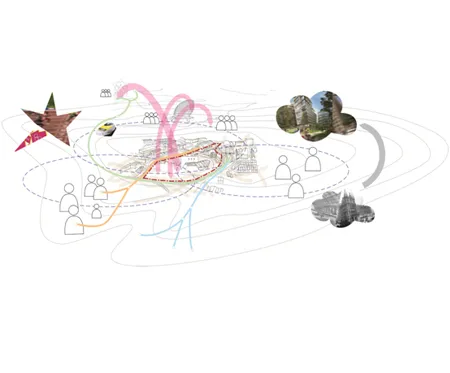
| Topic: The hypothesis developed at the chair for a "spatial strategy" approach is to be examined for its validity and relevance with colleagues from Germany and abroad. |
| Abstract: A workshop with experts from England, Switzerland, the Netherlands and Germany dealt with spatial strategies as a link between strategic goals and concrete spatial projects. Based on a hypothesis of what spatial strategy could be and practical examples, the workshop discussed how spatial planning can be made more effective. The importance of spatial qualities, how to attract the relevant actors to the process, the role of architectural design, the question of the interface to formal planning and the importance of visualisations were some of the topics discussed. Starting from the workshop, spatial strategies in teaching will be experimented with and the experience gained will be deepened. |
| Participating team members: Alain Thierstein, Juri Jacobi, Sebastian Haag, Anne Langer-Wiese, Agnes Förster, Michael Droß |
| Client: DFG, City of Munich |