
This was the website of the Chair of Spatial Development. The new website of the Chair of Urban and Spatial Development is currently under construction and will be available shortly.
Neue Dissertation: The Dynamic Geographies of the Knowledge Economy in Germany: Where do firms & workers locate?
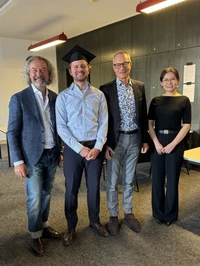
This dissertation examines the German knowledge economy over two decades and explores where firms and knowledge workers locate. It examines the spatial, relational and economic location decisions through three studies on firm location choices, the influence of the knowledge economy on employment growth and the (re-)location of workers. Using ERGM, Granger causality and origin-destination data analysis, it reveals how proximity, the type of knowledge, infrastructure and connectivity influence where firms and workers locate, thus, regional growth.
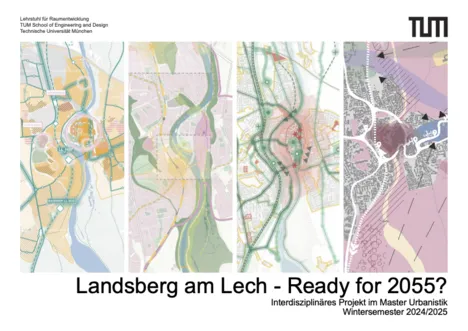
Project Documentation: "Landsberg am Lech - Ready for 2055?"
NEWS| 31.03.2025
Project Documentation: "Landsberg am Lech - Ready for 2055?"
Students from the Master's programs in Urbanism and Architecture worked for several months to look at the long-term development of the town of Landsberg. The aim was to design a long-term spatial strategy. Based on a comprehensive analysis of the region and a methodology for working with future trends, the next 30 years were examined. Four student teams each present a vision of the future for “Landsberg 2055” and use an overall strategy and specific spatial proposals to show possible development paths for the region and local stakeholders.
The four student teams focus on different topics and show different development paths for the year 2055. How can resilient land use, inclusive mobility and social cohesion be strengthened and interlinked to achieve sustainable growth? How can the prospects of young residents be improved and education and innovation become key catalysts for positive development? How can Landsberg become a municipality that leads by example through the consistent implementation of sustainable mobility, a liveable city center and a self-sufficient energy supply? And how can Landsberg carry today's qualities into the future in order to be “just as great, only better” in 2055?
Link to the digital documentation (PDF, ca. 70 MB) available on mediaTUM.
2011 Expert workshop "Making planning processes more effective"
Forschung, PAGE:TUMvCard |
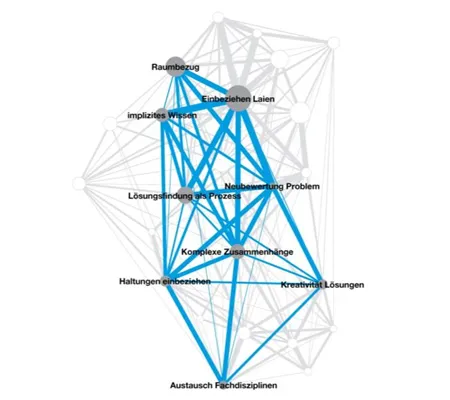
Topic: Discussion and validation of the research results of the project "Designing planning processes more effectively" with planning scientists and practitioners from the German-speaking countries, network building.
Brief description: The research project investigates the effect of process design in spatial planning processes. Compared to formally defined procedures, a process design adapted to the planning task according to the situation becomes more and more important. Planning methods are subject to increasing differentiation and specialisation. Access to process design is achieved through the interaction of the three essential basic components of planning methods: Analysis, visualization, communication. The innovative approach of the project refers to the value of existing and future procedures in planning processes through their systematic combination. The research project thereby systematically brings together experiences from different disciplines, methodological specialisations and different spatial scale levels.
Participating team members: Agnes Förster, Alain Thierstein
Discussion Paper Expert Workshop:
http://mediatum.ub.tum.de/node?id=1141869 (German)