Skip to content
  • de
  • en
  • Chair of Urban Development
  • TUM School of Engineering and Design
  • Technical University of Munich
Technical University of Munich
  • Urban Development
  • Team
    • Nadia Alaily-Mattar
    • Karin Eichinger
    • Matthias Ottmann
    • Former Team Members
      • Markus Weinig
      • Christiane Müller
  • Teaching
    • Current Student Projects
    • Completed Student Projects
    • Theses
  • Research
    • Ongoing Dissertations
    • Completed Dissertations
  • Publications
  1. Urban Development

This was the website of the Chair of Spatial Development.
 The new website of the Chair of Urban and Spatial Development is currently under construction and will be available shortly.

Neue Dissertation: The Dynamic Geographies of the Knowledge Economy in Germany: Where do firms & workers locate?

This dissertation examines the German knowledge economy over two decades and explores where firms and knowledge workers locate. It examines the spatial, relational and economic location decisions through three studies on firm location choices, the influence of the knowledge economy on employment growth and the (re-)location of workers. Using ERGM, Granger causality and origin-destination data analysis, it reveals how proximity, the type of knowledge, infrastructure and connectivity influence where firms and workers locate, thus, regional growth.

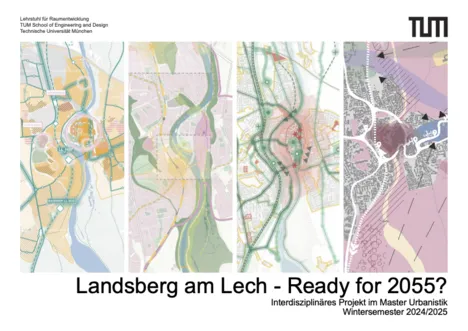
Project Documentation: "Landsberg am Lech - Ready for 2055?"

NEWS| 31.03.2025 

Project Documentation: "Landsberg am Lech - Ready for 2055?"

Students from the Master's programs in Urbanism and Architecture worked for several months to look at the long-term development of the town of Landsberg. The aim was to design a long-term spatial strategy. Based on a comprehensive analysis of the region and a methodology for working with future trends, the next 30 years were examined. Four student teams each present a vision of the future for “Landsberg 2055” and use an overall strategy and specific spatial proposals to show possible development paths for the region and local stakeholders.


The four student teams focus on different topics and show different development paths for the year 2055. How can resilient land use, inclusive mobility and social cohesion be strengthened and interlinked to achieve sustainable growth? How can the prospects of young residents be improved and education and innovation become key catalysts for positive development? How can Landsberg become a municipality that leads by example through the consistent implementation of sustainable mobility, a liveable city center and a self-sufficient energy supply? And how can Landsberg carry today's qualities into the future in order to be “just as great, only better” in 2055?

Link to the digital documentation (PDF, ca. 70 MB) available on mediaTUM.

2020 Mapping Urban Transportation Innovation Ecosystems

Forschung | 24.02.2020


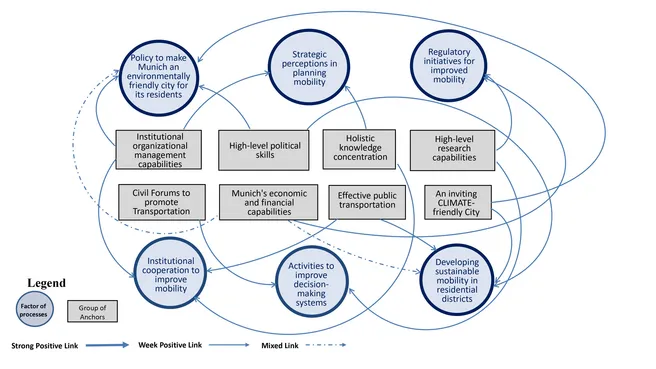
Topic: The TIE Project (Transportation Innovation Ecosystems) analyzes the actors, networks, and environments of innovations in the domain of urban transportation, i.e., the conditions that enable change with regard to the way we move in our cities. It does so comparatively in three European cities: Budapest, Prague, and Munich. TIE is a term used here to describe the diverse nature of the system's components and resources that act as a driving force for innovation in urban mobility. TIEs have many components, related to history, culture, legal/regulatory frameworks, education, science, and finance of a place, thus they are city-specific. In addition, some of the innovation system’s components are vital for the smooth functioning of the system—their presence and good working order are “necessary conditions.” Other components are “nice to have,” but not essential, and it is important to distinguish between the two.

It is crucial to understand how the TIE of every city works. Thus, we are constructing and implementing an innovative methodology to map, analyze, and enhance the TIE—a methodology that is applicable to any city or region. This methodology draws on existing expertise developed and successfully implemented to map National Innovation Ecosystems worldwide. It is based on interactive workshops; owing to the Corona pandemic, these have been supplemented by a web survey. In particular, the project aims to identify anchors (key actors, strengths) and processes in each city that are crucial to the development of transport innovation.

The aim is to create a strategic infrastructure for urban policy management in the field of urban mobility. This is done by defining tailored policy recommendations to improve the TIE in each of the investigated cities. The project suggests a service that enhances the ability of city leaders, policy makers, industry partners, entrepreneurs, scholars, civic stakeholders, citizens, and others to collectively agree on urban policy decisions that serve mobility interests, are system-wide in their nature, and exploit synergies to achieve agreed TIE goals.

The project is part of the EU-funded “EIT Urban Mobility” framework and its Strategic Objectives and City Challenges. In other words, this methodology will help identify creative, pro-innovation policies to enhance overall competitiveness in cities—toward meeting EIT Urban Mobility Strategic Objectives and City Challenges.

Researchers: Alain Thierstein, Fabian Wenner, Diane Arvanitakis

Principal: EIT Urban Mobility

Cooperation partners: Technion - Israel Institute of Technology (lead partner), Budapest University of Technology and Economics, Czech Technical University in Prague, Institute of Information Theory and Automation, LHM, SWM/MVG


◄
To top

Contact


Chair of Urban Development
Arcisstr. 21
D-80333 Munich

Room 4161
U-Bahn-Station Theresienstraße (U2, U8)

Phone
+49 89 289 22489

Email
info.re@ed.tum.de

Newsletter


Subscribe to our Newsletter here

  • Privacy
  • Imprint
  • Accessibility