
soft assembly
a project space by the Chair of Art in Architecture
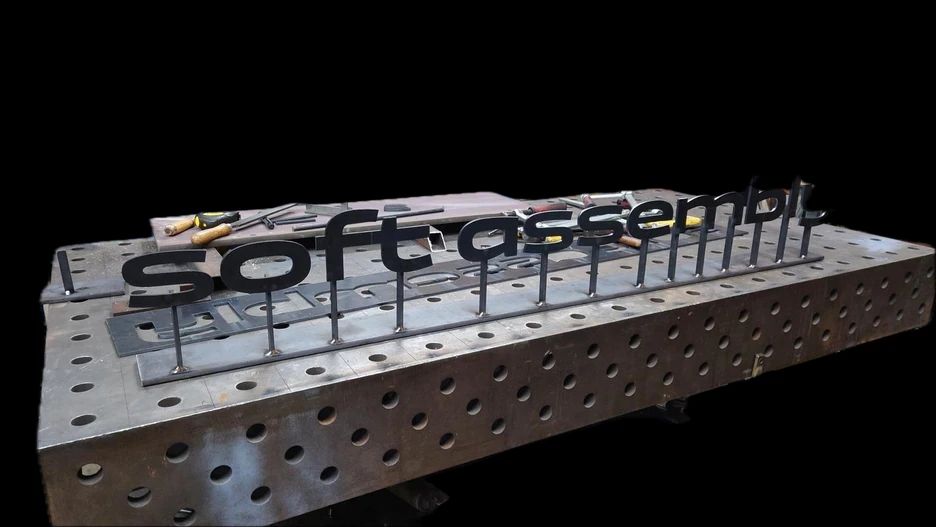
soft assembly is a project exhibition space in a renovated overseas container, located in the center of the TUM campus. The space is hosted and curated by the team of the Chair of Art in Architecture.
our wish is for soft assembly to be a site for emergent kinship and slow futures. A space where temporalities intersect, relations are brought into dialogue, and new modes of attention can develop beyond urgency and constant production. The space is conceived as a platform for reflection, experimentation, and exchange, foregrounding processes that unfold over time rather than immediate resolution.
soft assembly hosts regular exhibitions by professional artists from the national and international network of the Chair of Art in Architecture, presenting contemporary artistic positions that engage with spatial, ecological, and societal questions. Between these exhibitions, the space is activated through student projects and works developed within the semesters, offering insight into ongoing research, learning processes, and emerging practices. Together, these alternating formats position soft assembly as a continuously evolving exhibition space where art, architecture, and thought accumulate, overlap, and remain open to revision.
Location: University Street, TUM main campus, Gabelsbergerstrasse entrance.

Follow us on Instagram @soft.assembly.munich
EXHIBITION PROGRAM
CURRENT
October 2026

HELENE NYMANN
Future ContinuOnus
8 October - 27 November, 2026
The multi-faceted artwork Future ContinuOnus is part interactive website, part public sculpture and part video installation. Forming and framing an ever malleable map of memories for the futures.
The work is a site-specific video and sound installation that approaches the city as a temporal field where multiple durations intersect: geological, botanical, historical, technological, and personal. Moving through urban waterways, architectures, and reflective surfaces, the work unfolds as a sequence of suspended moments rather than a linear narrative.
At its core, an interactive platform invites visitors to contribute memories, which appear within the film as fleeting textual traces. Continuously rewritten, ContinuOnus becomes a living archive, like an evolving confluence of pasts and futures shaped by collective acts of remembering.
"If your memory was found in the future how do you think it would make the future feel?"
Future ContinuOnus has been shown in unique, site-specific versions at Copenhagen Contemporary in 2023, at Neue National Galerie in Berlin in 2025 and will now be shown in a new Munich specific version at soft assembly in 2026.
From 8 October visitors can submit their memories for the future via a QR code at soft assembly and visit the map Carte de ContinuOnus at www.continuon.us
21 July - 4 October, 2026

ANNA PASCO BOLTA
Apneas and Other Grammars: Second Breath
21 July - 4 October, 2026
Public opening: 21 July, 7pm
Apneas and Other Grammars is an artistic research project by Anna Pascó Bolta that explores the seabed as a living ecosystem and examines how we relate to environments that remain largely unknown.
Through a collaborative swimming practice developed with a group of elderly swimmers from Club Natació Atlètic-Barceloneta, the project engages their long-term sensory relationship with the sea, approaching their bodies as living archives of the coastline. Moving away from technical sport swimming, the practice develops a poetic grammar based on immersion, breath, synchrony and collective perception, where swimmers become part of the environment they inhabit rather than observers of it.
At soft assembly, Anna Pascó Bolta presents Second Breath, an experimental iteration of the project developed within her pre-PhD research at TUM, Chair of Art in Architecture. The exhibition brings together the video workApneas and Other Grammars, created in collaboration with video editor Ana de Mier y Ortuño, and the olfactory work Where Breathing Becomes You, developed in collaboration with Givaudan.
The project is made possible through the collaboration between the artist and Club Natació Atlètic Barceloneta, Institut de Ciències del Mar CSIC, and funded thanks to Barcelona Crea, Homesession and the SAC-FiC Programme at Sant Andreu Contemporani / Fabra i Coats.
PAST
8 May - 16 July, 2026

THE DIRTY ROOM ON GABELSBERGERSTRASSE – A Love Story In Three Acts
Student intervention over 12 weeks
BA experimental creation course, lecturer: Dominik Cosentino
Public opening(s):
Act I opens on 21.05.2026 13:15 - 16:00
Act II opens on 11.06.2026 13:15 - 16:00
Act III opens on 09.07.2026 10:00 - 13:00
***
Act I (no access)
Act I (no access)
Act I (no access)
Act I (no access)
Act I (no access)
Act II : (almost whispering) how can we continue with what has been left?
Act II : … with what has been made. How was this built?
Act II : it might be a new beginning?
Act II : (silent)*
Act II : there is no new beginning, I think. It’s a kind of continuation and
Act II : … and the stage in between
Act II : will we be forgotten?
Act II : never
*this project explores rhythmical absence, loss, and the ubiquitous significance of dirt through three sequential acts. as control slips from the hand that builds, structure begins to dictate the builder. dirt is reframed as a force that destabilizes hierarchies of artistic intent. rhythmical absence appears as the gap between the human desire for order and the unruly agency of matter.the room functions as a Foucauldian heterotopia, suspending norms of ownership and linear creation. Three groups successively enter the same space, inheriting the residues of prior actions. through this chain of compelled succession, the project becomes an exercise in radical receptivity, revealing the gradual dissolution of authorship
Act III (no access)(wondering in anticipatory expectation)
Act III (no access)
Act III (no access)
Act III (no access)(afraid)
Act III (no access) (reassuring Scene III)
22 April - 6 May, 2026

SIMON MULLAN
CHRONOS
22 April-6 May, 2026
Public opening: 22 April, 7pm
Simon Mullan’s video installation Chronos brings together 25 works created between 2004 and 2014 and reflects his artistic development within the tension between subculture, society, and personal identity. Inspired by the idea of film as an expression of reality (for example in the work of Pier Paolo Pasolini), the installation unfolds as a multi-layered, non-linear landscape of images and sound. Shaped by techno culture, social work (including work with refugees and people with disabilities), as well as socio-political themes, Mullan combines documentary and abstract elements.
The MiniDV aesthetic serves as a deliberate reference to a past media era, reinforcing the raw and immediate character of the images. The installation presents an intense, often provocative engagement with reality, physicality, and identity. Through numerous portraits, performances, and documentary scenes, a fragmented and emotionally charged overall composition emerges—one that offers fewer answers and instead invites perception and reflection.
Additional information: For each exhibition venue, Simon Mullan presents an adapted version of Chronos. This takes the form of a smaller installation with multiple monitors and a sound system, maintaining the immersive impact within a more reduced spatial setting.
Simon Mullan will hold a lecture on 22 April at 17:00
Open to the public
Lecture Hall 0220, Arcissstrasse 21, Entrance F5/6
***
soft assembly is designed by Munich-based SPACETOOLS