Master's Thesis
Last updated: 30 June 2026
The master’s theses at the Chair of Sustainable Urban and Rural Development present current positions at the intersection of architecture, urbanism, and landscape. They combine analytical research with design practice and develop spatial strategies for the transformation of existing structures and future spaces.
Living Instead of Retail
An Urban Hybrid for Neuhausen

Philipp Dopfer · M.A. Architecture · Summer 2025
Adaptive reuse of the Galeria Kaufhof department store at Rotkreuzplatz in Munich into a mixed-use urban building combining housing, public programs, and retail. (Language: German)
Patch:Works!
Transformation of a former department store

Annabel Matzdorf / Anna Lüssmann · M.A. Architecture · Summer 2025
Adaptive reuse of the former Kaufhof department store in Ingolstadt into a mixed-use urban building combining housing, workspaces, and public uses. (Language: German)
Constructing Communities
Creating Collective Interim Spaces during Urban Transformation

Simon Andreas Meindl · M.A. Architecture · Summer 2025
The project develops a collective corridor that connects fragmented spaces of the Munich North-East urban expansion and transforms them into shared, community-oriented places. (Language: German)
Back to the village
Sustainable development strategies for the secondary settlement of Schornweisach

Christoph König · M.A. Architecture · Summer 2023
The project develops spatial strategies to improve the quality of life in Schornweisach and combines local potentials with new impulses for sustainable rural development. (Language: German)
PHV Blue Green Grey
Sponge City Principles for Heidelberg's Knowledge City

Jodok Kroitzsch / Myriam Künzel · M.A. Urbanism · Summer 2023
The design develops part of the new town centre surrounding the former Patrick Henry Village and explores the role of public open space in balancing climate resilience and everyday usability. (Language: German)
Community Spaces
as Places for Learning in Indonesia

Ginnya Pryscilla / Prayudi Sudiarto · M.A. Architecture · Winter 2022/23
This English-language master's thesis explores community spaces in the fishing village Papela as social infrastructure within urban and rural transformation processes, developing spatial strategies for participation, exchange, and local development.
Interaction of City and Landscape
The Potential of Urban Edges in Saint-Benoît

Alix Gelabert · M.A. Architecture · Winter 2022/23
The development strategy limits urban growth and strengthens inner development through clearly defined urban boundaries. New uses enhance urban edges, creating additional housing and improving the relationship between the urban fabric and the surrounding landscape of La Réunion. (Language: German)
Transformation through Modernist Voids
Unlocking the Potential of Soviet-Era Housing Estates

Aidas Kazakevicius · M.A. Architecture · Winter 2022/23
The future of large-scale Soviet-era housing estates represents a major challenge for Lithuanian cities. Using Alytus as a case study, the thesis explores the activation of underused open spaces for sustainable urban development.
Rehab-Inhabit-Habitat
Redevelopment of Morozovsky town

Alexandra Bayborodova · M.A. Architecture · Summer 2022
The former Morozovsky workers' settlement lost its original purpose following the decline of the textile industry. This English-language thesis develops a transformation strategy that uses the industrial heritage as the foundation for a mixed-use and connected urban neighbourhood.
KLEINstatt GROSS
Urban Potential Eichstätt

Laura Tutsch / Alex Meyer · M.A. Urbanism · Summer 2022
Using the small town of Eichstätt as a case study, the thesis develops strategies for addressing structural functional decline and vacancy while outlining concrete perspectives for strengthening small-town structures and future development. (Language: German)
Diffuse Athens.
Suburban realities

Spyridon Koulouris · M.A. Architecture · Winter 2021/22
Athens is a polycentric city without a clearly defined centre. The project develops multifunctional strategies for its diffuse suburban areas, combining ecological, spatial, and mobility-related approaches into a sustainable model for urban development. (Language: German)
A Small Village with a Great Future
A Sustainable Development Strategy

Ann-Sophie Megerle · M.A. Architecture · Summer 2021
The sustainable development strategy for the village of Löschenhirschbach demonstrates how vacant buildings, new housing models, and community-oriented uses can strengthen the long-term future of small rural villages and create new development perspectives. (Language: German)
Between City & Landscape
Reimagining a Landscape Park for Regensburg

Nicola Stadler · M.A. Architecture · Summer 2021
A new landscape vision for northern Regensburg strengthens the relationship between city and landscape while creating long-term perspectives for sustainable regional development. (Language: German)
Second-Line Impulses
Markt Teisendorf

Katharina Wagner · Independent M.A. · Winter 2019/20
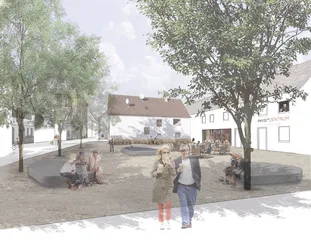
Unlocking the development potential of the "second row" creates new housing, activates existing buildings, and strengthens the historic settlement structure as the foundation for sustainable town development. (Language: German)
Rethinking Inward Development through Village Structure
Three Strategies for Successful and Identity-Building Densification in Hüttwilen

Ferdinand Schachinger · M.A. Architecture · Summer 2019
Three differentiated densification strategies for Hüttwilen demonstrate how high-quality inward development strengthens village structures while combining organic growth with spatial identity. (Language: German)
A Regional Spatial Framework for Bellinzona
Development Perspectives for a Merged Municipality

Bernadette Brunner · M.A. Urbanism · Summer 2018
The municipal merger is understood as an opportunity to reconnect fragmented spaces and create a shared spatial identity. A regional spatial framework provides new development impulses while strengthening cohesion across the merged municipality. (Language: German)
After the bypass
Village Development along the Brenner Road – Gossensass

Laura Haller · M.A. Architecture · Summer 2018
The planned bypass becomes the starting point for sustainable village development that activates vacant buildings, strengthens the historic village centre, and creates new perspectives for living, working, and community life. (Language: German)
Liangxiang
Urban-Rural Transformation in Southern Beijing

Yunmeng Zhang · M.A. Urbanism · Summer 2017
A careful transformation combines Liangxiang's cultural landscape with new residential and economic functions, creating long-term perspectives for local communities, recreation, and sustainable urban development. (Language: German)
Living Small Towns
Heilsbronn

Anne Gruber · M.A. Architecture · Summer 2017
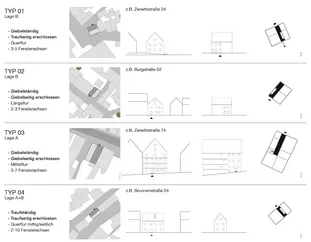
Using Heilsbronn as a case study, the project demonstrates how housing in the historic town centre reduces vacancy, limits land consumption, and revitalises the urban core. Diverse housing models strengthen neighbourhoods and support sustainable development. (Language: German)
Werkstatt Wallersdorf
New Ideas for Rural Settlement Transformation

Theresa Friedrich / Johannes Hemmelmann / Julian Numberger · M.A. Urbanism · Summer 2016
New housing models, high-quality infrastructure, and an attractive cultural landscape become key components of sustainable settlement transformation, creating new development perspectives for Wallersdorf and other rural communities. (Language: German)
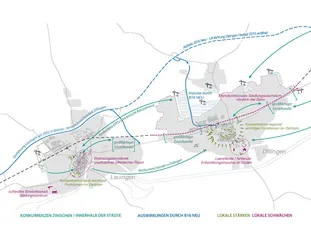
Strategy for the Coordinated Development of Four Small Towns
Gundelfingen, Lauingen, Dillingen and Höchstädt in the Swabian Danube Valley

Denise Ehrhardt · M.A. Urbanism · Winter 2015/16
An intermunicipal development strategy demonstrates how cooperation rather than competition can secure the future of four neighbouring small towns. Regionally coordinated priorities strengthen town centres, reduce vacancy, and create new opportunities for the entire region. (Language: German)
Development Strategy for the Northern Chur Rhine Valley
A Landscape in Transition

Jan Stadelmann · M.A. Urbanism · Summer 2015
The development strategy understands the ongoing transformation of the Chur Rhine Valley as an identity-forming quality. Targeted interventions strengthen existing landscapes, create new spatial qualities through the interaction of infrastructure, material flows, and nature, and develop the fragmented landscape into a coherent living and recreational environment. (Language: German)