

Fid Fischer (Julia Sie-Yong Fischer) she/her, is a visual artist and writer based in Berlin. She completed her Master’s degree in Political Science, Art History and Fine Art in Marburg. She then studied Contextual Painting under Prof. Daniel Richter at the Academy of Fine Arts in Vienna and completed her diploma under Prof. Ingo Meller at the Academy of Visual Arts in Leipzig. In her painting, she explores spaces that are essentially invisible. She takes scientific images and develops them further, examining them visually. Her artistic practice is closely linked to her artistic writing. She is also a journalist who publishes articles about exhibitions and phenomena in the art world.

Michael Mieskes (he/him) examines pictorial practices situated between sculpture, painting, and digital modeling. He holds a Bachelor of Arts in Industrial Design (Pforzheim University), a Diploma in Fine Arts (ADBK Munich) and a Master of Arts in Aesthetics (Goethe University Frankfurt/M.) with a focus on Philosophical Aesthetics, Media Theory, and Theory of Architecture. He recently completed his PhD at the Faculty of Philosophy and History at Goethe University Frankfurt/M., investigating the effects of digital technologies on artistic practice. (Title: "Technologische Bildlichkeiten. Digitalität und Mimesis nach Adorno", publication forthcoming in 2026.)
Michael Mieskes‘ practical and theoretical interests include the influence of (digital) technologies on the arts, mimetic practices, and artistic material. He received scholarships from the Digitalization Initiative of the Zurich Higher Education Institutions (DIZH), Bauhaus Stiftung Dessau, Stiftung Kunstfonds, among others.

Marie Dubus (she/they) is a digital artist and lecturer working between Berlin, Munich and Paris.
Her transdisciplinary practice engages with digital media, urban studies, and speculative fiction to explore how bodies inhabit public spaces. Drawing from science fiction, video games, body horror, and ruin aesthetics, her work envisions the city as a porous, mutating entity where technology, architecture, and identity constantly coalesce and collapse.
Grounded in research and built through collaboration, her immersive installations and virtual environments serve as speculative blueprints for alternative forms of cohabitation. These digital spaces often emerge from collective processes, inviting musicians, poets, performers, and textile artists to explore collective storytelling.
Marie Dubus’ recent works address themes of chronic illness, consent, and identity in urban-digital contexts. Her technical approach blends a wide range of digital tools and platforms, allowing her to craft immersive environments that question how emerging technologies reshape our relationship to the body.

Annegret Hoch (she/her) is interested in “painting as subject matter.” Her work spans an arc from the traditional panel painting to the question of how far the playing field of painting can be extended. Bold colors and a sophisticated handling of the respective space are constants in her oeuvre. New in her recent work are colors derived directly from nature. The artist now uses beet and elderberry juice as well as sepia to extend the vocabulary of color theory.
Collages play an important role in Hoch’s work. Here, materials undergo a process of transformation, losing their original meaning. In 2019, the artist began extending the collage concept into three-dimensional space. Mundane office materials, in this case standard A4 and A3 sheets of paper, form a kind of “background noise” running through the various cycles. The key aspect of these room collages is that they are created directly on site, formally incorporating and continuing distinctive architectural elements or features such as exposed pipe systems.
www.annegret-hoch.de
View full bio here
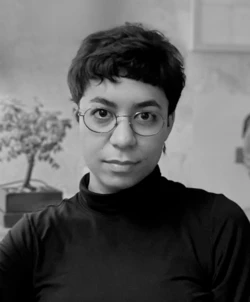
Lídia Chaves (she/her) is a Brazilian artist currently based in Stuttgart, where she is completing a Master's degree in Architecture at the University of Stuttgart under the guidance of Prof. Sybil Kohl and Prof. Stephan Trüby. Working at the intersection of art and architecture, her practice blends a strong interest in language and storytelling with archival research, exploring the poetics and politics of space.
Her public installations NEBEN DEM KAKAOFELD and bei Nills are part of an ongoing research exploring the traces of colonial spaces in Stuttgart. In collaboration with the Kulturamt Stuttgart and the city's Office for Remembrance Culture (Koordinierungsstelle für Erinnerungskultur), she is currently working as an ambassador for decolonial memory, contributing to the development of new strategies for remembrance culture.
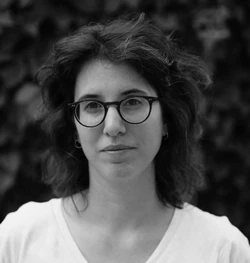
Anna Pasco Bolta (she/her) was born in Barcelona in 1990. In her work she explores how life and existence are constructed through research intertwining art, science, and technology from an ecological and relational perspective. Her transdisciplinary work examines systems of coexistence and proposes co-creative ways of relating to other species, combining art theory, gastronomy, and performance to challenge Western dichotomies. She is currently part of the SAC-FiC program at Fabra i Coats Center (Barcelona) and collaborates with the Institut de Ciències del Mar (ICM-CSIC) and the Club Natació Atlètic-Barceloneta (CNAB).
Her practice involves situated artistic research and performance-lectures, including recent works like "Shapeshifting and Reworlding" at the Naturhistorisches Museum Wien (2025) and "Salt’s Longing" at LMU Munich’s Global Health Day (2025). Her work spans artistic, academic, and scientific fields, having been presented at the German Congress of Infections and Microbiology (2024), the Electromicrobiology Congress (Denmark, 2023), and the X-Festival (Belgium, 2023). This international career is defined by sustained collaborations with scientific institutions across Germany, Denmark, Belgium, and Spain.
For several years, she has combined research with teaching at the Chair of Fine Arts at the Technical University of Munich (TUM) and the Faculty of Arts of the Universitat de Barcelona, focusing on material ecologies and art–science methodologies. She holds a degree in Fine Arts from the University of Barcelona and the Akademie der Bildenden Künste München, graduating with honors. Her work has been exhibited at Haus der Kunst (2024), Gallery Herold (2025), Starnberg Museum (2025), Bienal Off Cairo (2023), Festival Speculum Artium (Slovenia, 2022), ISEA-Festival (2022), La Capella (2022), and Kunsthalle Kempten (2021).
She authored "Stickers" with Bom Dia Books (2022) and publishes in journals such as "INMATERIAL" (2025) and "Cultural Geographies" (2024). Pasco has participated in international residencies including L’Automàtica, Entorno al crear y lo creado (Chile), Fabrikken (Denmark), the Arctic Circle Program, ArtWaves/UN Ocean Decade, La Mire (France), ÉCART/Homesession (Canada), Malt AiR (Denmark), Almresidency, and the DAAD Postgraduate Residence (Vienna). Her work has been recognized with the Barcelona Crea Homesession (2025), Ricard Camí Prize (2025), the Alexander Tutsek Foundation (2024), Stiftung Kunstfonds (2022), Barcelona Producció (2021), and Kunstpreis 15HOCH2.
View full bio here