
Tabletopia: Rethinking the Table as an Emotional Experience
About the Project
Tabletopia is an experimental, research-driven Master project taking place in the summer semester 2025, focusing on reimagining the everyday table beyond its conventional use. Students were challenged to rethink the table beyond its conventional function. Instead of treating it as a neutral surface for work, they were asked to imagine it as an emotional artifact that influences behavior and communication. Grounded in Pieter Desmet's Emotion Typology, they researched positive and negative emotions and translated these abstract emotional states into table designs.
A key goal of Tabletopia was to combine a hands-on design project with design research. The goal was not only to create expressive and interactive table prototypes, but also to test their psychological impact. Each team of two students formulated a research question alongside their design concept and developed a small empirical study to evaluate whether their table actually evoked the intended emotion. The semester therefore merged prototyping, observation, data collection, and reflection. Students were not only designers, but also researchers running small-scale pilot studies.
The semester's outcome featured five table designs exploring the emotions of annoyance, boredom, confusion, fascination, and serenity.
Annoyance Table
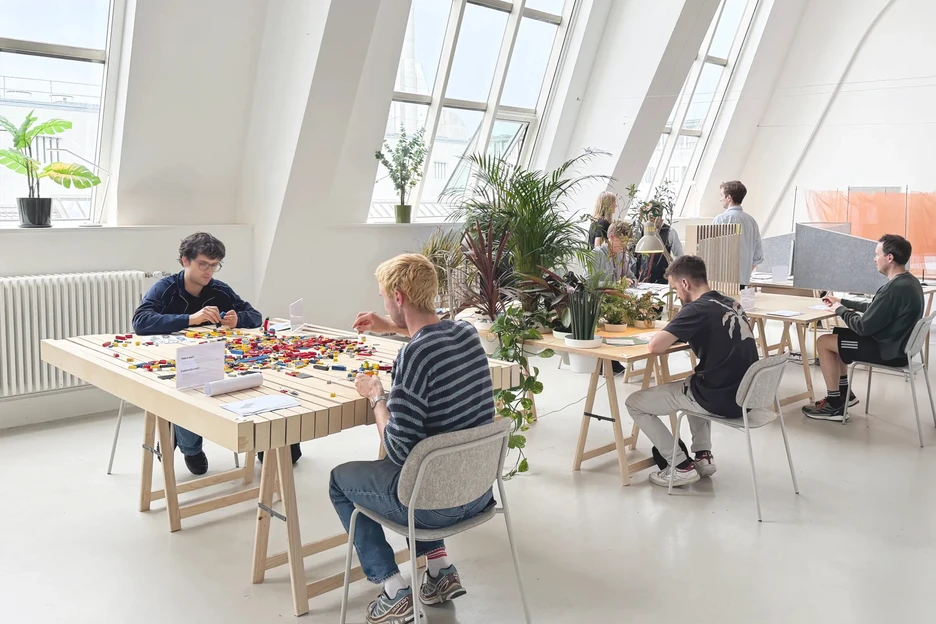
The Annoyance Table by Valerian Diez and Philipp Jung explored the emotional state that arises when goals are blocked, control slips, or cooperation becomes strained. Participants competed to build LEGO models across from each other on a vibration-sensitive surface that transmitted their movements to the other side. These disturbances turned a simple task into a strategic exchange, revealing stress patterns, altered time perception, and differences between friends and strangers. The project showed how quickly cooperation can shift into tension when control is lost.


Boredom Table
The Boredom Table by Jesper Druckrey and Lennart Kremerskothen emphasizes stillness and monotony, allowing space for reflection despite its negative perception. Organized in a grid with gray-highlighted zones for rule-based interactions, two participants sit on opposite sides of a translucent Plexiglas screen. Minimal stimuli, including a clock with unmoving hands and a glass of water, highlight disengagement. Participants recorded their emotions using scales and interviews, showing that reduced encouragement affected their perceptions of time, attention, and mood, and occasionally sparked unexpected thoughts.


Confusion Table
The Confusion Table by Jana Lohr and Lena Mayer highlights the cognitive tension that arises when new information contradicts existing knowledge, highlighting the mind's pursuit of coherence. The table translated this discrepancy into a spatial experience by subtly disrupting logical expectations through mirrors. As a result, initially clear tasks contain inconsistencies, forcing participants to reinterpret instructions and outcomes, leading to hesitation and cognitive searching as participants sought to restore order by adapting to new rules, questioning assumptions, or forming new connections.


Fascination Table
The Fascination Table by Heather Roche and Rossa Brennan Kelly explores curiosity and sustained attention through form, movement, and material. At its center, a responsive water feature animated the tabletop. A responsive water feature at its center animated the tabletop, while concentric channels in pale timber guided the eye inward. Sheer fabric panels above created shifting shadows, and steel rods with washers produced delicate sounds when handled. The table promotes tactile and visual exploration, examining how subtle sensory stimuli influence engagement and focus.


Serenity Table
The Serenity Table by Lowie Bouckenooghe and Paul Osiander aims to evoke a sense of calm, peace, and tranquility by integrating plants into the tabletop, creating a soothing atmosphere with gentle colors and textures. Engaging in the mindful activity of folding an origami crane, a task that balances both difficulty and reward, should support achieving a state of serenity. The table served as a small refuge, reducing stress and promoting clarity, especially during the intense final weeks of the semester.


Exhibition
The semester concluded with an immersive exhibition at the IPD Summer Exhibition, where visitors had the opportunity to experience the five emotional tables firsthand and engage with the research findings. The studio transformed into a living laboratory, demonstrating that even the most familiar objects can be reimagined as mediums for emotional exploration.
Summary
Looking back on the Tabletopia project, it showcased the benefits of combining creative design practice with empirical research. By integrating small-scale studies into the design process, students learned not only how to shape experiences but also how to evaluate their impact. The table evolved from simply being furniture into a catalyst for emotion, reflection, and a deeper understanding of how design influences human experience.